Returning to our series on young people who have rejcted modern notions of adolescence, Mother-Lode is pleased to introduce Melissa, Bev's eldest daughter.
Melissa is a high-school graduate, currently taking a gap year to save up for college so she won't go into debt. She was the third place value debater and first place debate speaker in the nation at the 2003 NCFCA national tournament. In the fall of 2003, Melissa was a Communicators For Christ intern, speaking and teaching at 12 conferences in 12 states. During her tenure with CFC, she co-wrote the first Value Debate track offered to beginning debaters. For three years, she has been a contributor to a nationally-recognized value debate textbook, Lincoln-Douglas Debate: Guidebook for Debating the (current Year) Value Topic, and has been a debate club organizer and tournament administrator. Melissa was the youngest member of the Executive Committee for Chaves County Republican Women, serving, at various times, as Newsletter and Legislative Alert committee chairs. Last year, Melissa interned at her state capitol, where she used her debate skills to aid statesmen who support homeschooling ( a rare breed in her liberal state). In August 2004, Melissa travelled to New York City as a page for the Republican National Convention. Ultimately, she aims much higher than politics; she plans on changing the world as a teacher, one child at a time.
Mother-Lode: How did your family decide to homeschool you through high school?
Melissa: I actually had to ask my mom about this one! From my perspective, there was never really any choice--I simply followed where my parents led, and eventually that meant homeschooling in high school.
Even my parents, though, never said to each other, "We're coming up on high school now...should we keep doing this or not?” The just continued their commitment to obey God’s call for our family, which meant homeschooling (unless otherwise forcefully notified from above).
Mother-Lode: Many outside the homeschool community assume that homeschoolers either have a very affluent background or an extremely limited background - possibly abusively so. What part has adversity played in shaping your character and education?
Melissa: My mother has for many years alternately battled, suffered under, and succumbed to a disease called Fibromyalgia. Simply, her body doesn’t repair itself at night from the stress of the day as efficiently or as well as yours and mine do. Instead, she wakes up every morning with the previous day's wear and tear already pulling on her joints and muscles, which means that most days she is either in serious pain or desperately tired.
This has forced my sister and I to learn a lot of character traits by necessity. Compassion, especially, is a character trait that I’m sure I would never have learned half as well if Mama hadn’t struggled so much. Independence, or Self-Reliance, is another character trait that I was taught very early because Mama simply couldn’t make breakfast every morning as soon as I woke up, or teach math when she had a migraine; ergo, I had to sink or swim very fast. Of course, I wasn’t abandoned without guidance, but I learned how to study on my own sooner than many of my friends.
Besides requiring a lot of independent study, Mama's Fibromyalgia meant that a great deal of my high school education was much more hands-on and practical education than most. My transcript includes several long “practica” on home management (basic repair, home economics, lawn maintenance, interior design, time management, etc.) that started as “just helping my mom” and developed over time into true courses.
There’s another important area where our family adversity has shaped my character—it’s brought me a lot closer to my dad that I would have been otherwise. In facing our family’s difficulty, and in working to keep the house running when mama wasn’t able to, we’ve learned (the hard way!) how to really communicate with each other. Through the really tough times a few years ago, Daddy was the one encouraging me, teaching me and guiding me through the process of keeping our house in order. I've learned to rely on him and trust him more than I would have if Mama had been able to run things all the time.
Mother-Lode: What projects in your high school career have seized your imagination?
Melissa: Teaching public speaking and debate to students and parents has been one of my biggest projects and my biggest loves in high school. I love simplifying the difficult concepts of academic debate and putting them in understandable terms, and I love encouraging students with feedback and critiques. I loved my five years of competition in the National Christian Forensics and Communications Association, but this past year I was able to finally be on the side where my heart truly lies—coaching and helping run tournaments.
Now that I’ve graduated, and will probably be going off to college, I’d like to help other tournament administrators, especially new ones in states that are just beginning to have NCFCA competition, by sharing what I’ve learned behind the scenes at a large variety of tournaments. I’m not sure yet if it will be by writing a book or over the internet somehow (since I’ll be away at school), but I definitely want to stay involved with the NCFCA. I also want to do something along the same lines for value debate teachers and coaches—give them the support I never had as a “loner” in the debate world. The other project that I thoroughly enjoy is desktop publishing, especially layout and design work. Several years ago, I helped my parents edit/compile the handbook for our state convention, and discovered that I have fun making words look good on a page. Actually, I’m continually fascinated by all the capabilities of technology (not just professional-quality layout from a home PC), and one of my hobbies is to keep abreast of technological innovations.
To be continued...
Friday, November 04, 2005

Tuesday, November 01, 2005
Standing on Titans' Shoulders

November 1, All Saints' Day. Today is the day when Christians have traditionally remembered all the faithful who have gone before. It's a practice which most Protestants have relegated to the scrapheap of superstition. But reflection need not be superstition, and there is much we could learn by remembering and reflecting upon the lives and deeds of our spiritual fathers. Indeed, without thoughtful reflection, we live on their legacies like squatters rather than like sons.
Last week's San Antonio Christian Independent Film Festival was food for some of this inter-generational reflection.
When I was in college, my peers and I, like every young generation, wanted to change the world. We talked and prayed about taking over academia, achieving political influence, capturing the culture's imagination through the media, bringing down Communisim with the Gospel, and financing it all through our own private businesses. We haven't gotten very far.
Most of my generation had no desire to connect with those who had gone before, and to be fair, most of the previous generation had nothing much to pass on. As Francis Schaeffer put it, they were concerned chiefly with "personal peace and affluence". (Though my parents were an exception to the rule.) We had to learn to look farther back for shoulders on which to stand.
However, at the Film Festival, most of the filmmakers were my generation's children. And they were consciously standing on our shoulders, working to accomplish those things we had only dreamed and prayed. Probably the one thing my generation has been able to do, is to raise children on purpose, training them in the vision we have not been able to attain. But we have been able to give them shoulders on which to stand.
Friday, October 28, 2005
Conquering Sons

If art is warfare, then praise would be the most devastating weapon in her arsenal. What other weapon is inhabited by God? (Ps 22:3 "Thou art holy, O thou that inhabitest the praises of Israel.") What other brings down city walls (Joshua 6), busts up prisons (Acts 16:25 ff) and scatters armies without a blow (2Chron. 20)? The cherubim who guard the throne of God, wall it around with chants of "Holy, holy, holy, Lord God Almighty, which was, and is, and is to come!" (Rev 4:8)
Where are the strong young men who will learn to wield this weapon with skill and finesse?
We have become such a limp-wristed bunch! Gone are the days when strong men sang poetry in public in order to brace up the troops for battle. Gone are the warriors who knew they would prevail if the bagpipes led them into the teeth of the fray. And it should come as no surprize to us, that praise in worship is no longer percieved as a manly thing.
Our sons will conquer by praise as we train them to think of it as a sort of swordplay. They already know how a put-down cuts. We must show them the true use of the tongue's cutting edge. Every word of worship and praise to God a cut to His enemies. Every song a death-blow to the despair that characterizes our present age, and a clarion call to rally the juggernaughts of Heaven. Until the accumulated praises raze the strongholds of the evil one, free his prisoners, and scatter his minions in shame and confusion.
In my speech club, we have an exercise we call "heavy-lifting", in which we practice introducing one another with praises. It is the inverse of the put-down, a cut to Satan's enticement to us to use our speech to cut each other. It is the only exercise for which prizes are awarded on the spot. Praise is becomming cool, and more importantly, it is becomming a habit.
This coming holiday season, I will be working to teach my son, who has recently come into his bass voice, to sing the bass lines of the hymns and carols of the season. I hear him flailing around trying to find a line that is comfortable in his new range, and realize that this voice change handicaps young men in praise at this vulnerable stage. Perhaps we can use this as an opportunity to train them to think of praise as their weapon of choice, and to expect to work out on the sparring ground as a regular feature of life.
In mediaeval times, it was a woman's office to gird a young knight with his sword. All around us are men who have forgotten the use of the sword. But while it will necessarily fall to men to perfect the skills of praise in our young men, I hope I will be belting on plenty of swords. I want to see the wicked strongholds fall.
Worship and Conquest

The San Antonio Independent Christian Film Festival is in full swing. In its opening ceremonies, organizers expounded the theme of art as warfare, a juxtaposition that may seem jarring. However, I think it is an apt comparison.
In his exposition of Old Testament bibilical themes, Peter Leithart points out that the first battles of Joshua's conquest were fought on the same ground where Abraham had built altars centuries before. This means that worship consecrates the land on which it is conducted to God. It becomes holy ground, set aside for Yahweh's use and pleasure. "Worship is the pre-conquest of Canaan..." as Leithart says.
The line between worship and art is a fine one. Certainly art participates in worship. Art is the handmaid of worship. Everything that God established in the Old Testament worship templates drips with art. Embroidered tapestries were the walls and doors of the Tabernacle. The furnishings were finely wrought gold, silver and brass. The air was perfumed with incense. The priests wore gorgeous robes. The rituals performed by the worshippers formed a stately dance of repentance and redemption, which ususally climaxed with a banquet in God's presence.
In our day, our culture's imagination is an un-conquered pagan stronghold. It will not fall to the haphazard efforts of un-connected individualists, who are in it for the fun or the fame. No, it will need an army of true artists, who will craft their work as both worship and warfare.
Jericho fell to the trumpets announcing the arrival of the True King, Whose throne was carried on the shoulders of the Levites. The swordplay that followed was a mop-up operation. King Jehosaphat (2 Chron 20) turned the tide of a hopeless battle by sending out Levites singing the praises of God. We would do well to follow their example.
Wednesday, October 19, 2005
Professional Mothers - Bev 2

Today, we continue the interview with professional mother, Bev. Just for the record, Bev notes that her work with the InterVarsity Urbana conferences was done as a stay-at-home wife BC (before children).
Mother-Lode: In the course of your work as a mother, what kinds of things have you done?
Oh, goodness! All kinds of things!
The longest and most challenging thing I’ve done is home schooling my two daughters, who are now 19 and 17, for the past 15 years. My oldest, Melissa, graduated from home school this past summer and Margaret has two years to go before graduating. This has stretched me beyond anything I would have imagined when Melissa came to us at age 4, begging to be taught to read. I’ve gotten the education I never had or simply forgot, and I’ve come to realize how much more I still have to learn.
I have taken great pleasure in learning to do new things and challenging myself to do things I already know better. If I say so myself, I’ve become a really good cook. A year ago, I found out that I’m allergic to all foods containing gluten (wheat, oats, barley and rye) and have learned that it’s possible to cook wonderful meals without any of those ingredients. In addition, I have to try to find recipes that don’t include dairy (or where it can be added on the side) or tomato because of the girls’ allergies. Try matching that challenge! In the past couple of years I’ve begun an herb garden, which has been a lot of fun and has added to the flavors I use in my cooking.
I’ve taken a course in Interior Design at our community college, and put those new skills to work in making our home beautiful. This has included re-upholstering our couch, learning faux finishes for the walls, and making drapes. The best part of our biggest design project was that the girls and I did all the planning, shopping and work ourselves while Tom was out of town taking care of his mother. It was so fun and challenging to make it a “girls project” and to learn how capable we really are.
We’ve traveled quite a bit around the U.S. for speech and debate, seeing all kinds of new things and making friends. When the girls were quite small (2 & 4) we lived in American Samoa for two years while Tom worked for the Samoan Attorney General. The girls don’t remember much of it, but living in another culture and making friends from around the world enriched my life tremendously.
Mother-Lode: How have you dealt with the feminists' view that a career is all-important for the full development of women, and with the pull of careerism in your own life?
The feminists’ view of a career being necessary for the full development of women needs to be seen for what it is: a false dichotomy. They hold up a career as the means of women developing themselves, because they have failed to see the challenge of parenting done well. I believe they think of a housewife as someone who sits around watching soap operas and eating bonbons, failing to use her mind in any productive manner. Ultimately, I believe feminism is selfish, setting up the plaint I frequently hear, “But what about me?” In a hierarchy of values, what I want to do is more important that what others need from me.
Being a good mother and wife is hard work; it takes a lot of energy and creativity and know-how. How the feminists can say that all this isn’t fully developing my mind and isn’t fulfilling is quite simply beyond me! Titus 2:5 says that among other things, women are to be busy at home and a repeated character trait of the Proverbs 31 woman is that she is industrious. However, she isn’t just “stuck at home”; she has a business selling linen and sashes to the merchants, understands how to make wise land purchases and how to grow a vineyard.
There are so many possibilities of things a mother can do that are fulfilling both at home and outside her home. The trick is to find those things in which you can include your family. I will admit it may be hard to see anything fulfilling about changing the umpteenth diaper or doing another load of laundry, especially when our children are very young, but even in those years it can be done.
God had generously given me gifts in the area of administration, and using those in the areas I chosen for involvement has definitely settled the question of “careerism” in my life. I have good, intellectually challenging work to do in a variety of arenas, including my home and family. A benefit is that as my family changes and my interests change, I have the freedom to move on to the next arena without the fear of any employer giving me a poor job reference.
In the realm of home schooling, I was the leader of a local home school support group for several years and am called on annually to speak to a group of community leaders about home schooling. I have volunteered in several capacities for the NM home school convention, doing the desk-top publishing for the convention handbook and leading several workshops. In our community, I have volunteered at the Community Kitchen , teaching adult Sunday School, coached the Bible Quiz for AWANA, and been Superintendent of the Arts and Crafts building at the Eastern New Mexico State Fair.
In learning along with my daughters, I have become a public speaking coach and have learning to coach and judge debate. These skills have put me in place to help run the NM speech and debate tournaments, primarily working with the community judges.
I am also a past-president of Chaves Country Republican Women, one of the largest Republican Women Clubs in NM. This was a tremendous challenge, because it covered the time frame of re-electing both President G.W. Bush and a highly effective freshman representative to Congress. It involved educating women about the political process, raising funds for candidates, walking precincts and lobbying legislators in Santa Fe.
Every one of these activities included the girls or came about because of home schooling them. The support group was a family activity, the girls were runners at the Fair and later moved up to taking in exhibits and arranging them for display. Republican Women welcomed them with open arms and put them to work, and even created a new category of membership for girls who are not yet 18.
Mother-Lode: How would you advise a young woman about to graduate from high school?
Don’t just “settle” for what our society may be telling you to do. Life is fulfilling and challenging when you go about it purposefully and intentionally. Think about what you are doing and the choices you are making. Are you only doing it because everyone else is doing it? The better things in life come when you choose to do those things that are inherently difficult, because the rewards and satisfaction are so much greater.
Mother-Lode: What have been the returns of your labors as a mother?
First and foremost, I have grown in my relationship with the Lord. I have been pushed back into Scripture time and again, and I have had to rely on Him daily. I don’t want to sound like everything is sunshine and roses – there have been many, many days when I have started the day simply asking for the strength to get out of bed and open my eyes (in that order!). Overall, my knowledge of Scripture has grown because I have wanted my girls to have a greater knowledge of God and His purposes in the world than I had growing up.
I have become much less selfish, much more competent and much, much more confident in my personal abilities. I used to have a lot of ideas and opinions but was afraid to express them for fear of what others would think; as you know, that doesn’t seem to be a problem any more!
In teaching my daughters to respect their father, I have gained a far deeper respect for all that he does, which in turn has made my love for Tom all the stronger.
I have a wonderful relationship with my daughters; I count them among my dearest friends. I know so many women who have teenage daughters, who look at them rather helplessly and murmur “Oh, well, this too shall pass. We just have to let her get this [whatever ‘this’ may be] out of her system” or they ring their hands feeling impotent as a parent to have any influence in the lives of their teens. We have not had this experience, and I’m convinced it is God’s blessing in response to our obedience to home school, and the constant 24/7 input we have been able to have in the girls’ lives. We sit up late at night and talk and giggle and frequently talk about the things that are on their minds, and this has built trust between us, so that the girls will talk to me about all that is going on in their lives, whether it is fashion, theology, work or relationships with their friends. What a tremendous blessing for a mother!
Overall, I can’t imagine NOT being a mother. My life is rich with experiences, but most of all, rich with the love of my family. Through being a mother, I know, too, that my life has made a difference in the lives of others. I already see results through the influence of my daughters on others’ lives, and can’t wait to see what they are going to do as mothers. (Actually, I can wait. I’m just looking forward with great anticipation!)
Mother-Lode: If you had it to do over again, would you make the choice to be a professional mother?
Absolutely! Only…. Would I get to keep all the things I’ve learned this time around?!
Tuesday, October 18, 2005
Professional Mothers - Bev

Meet Bev. Wife of Tom, mother of Melissa and Margaret. Homeschool teacher for 15 years.
In the course of her stay-at-home career, she has worked for InterVarsity Christian Fellowship's Urbana conventions, organizing small group Bible studies, seminars and exhibits for 18,000+ attendees. She has won so many cooking, sewing, canning, and arts awards, that they finally gave up and made her Superintendent of Arts & Crafts at the Eastern NM State Fair. Bev served on the Republican Party of NM State Central Committee, and was precinct chair of Chaves County Republican Party Central Committee. Citizen lobbyist and invited advocate for home school and family issues at the NM Legislature and at Leadership Roswell for 10 years. She is the National Christian Forensics & Communication Association's State Representative for NM, and has run more high school tournaments than you can shake a stick at. As a local speech & debate coach, she has worked with middle schoolers, high schoolers, the Optimist Club, Communicators for Christ, and has assisted forensics programs in Texas, Arizona and Colorado.
Bev is currently the Republican Party's best hope for winning state office - but NOT, she says to Party officials who come, hat in hand, to her door, until Margaret, her youngest, graduates.
Lest you dismiss her as just another financially fortunate Type-A show-off, realize that Bev accomplishes all this on Tom's modest public-defender's income, while living with Fibromyalgia (a debilitating chronic fatigue syndrome).
If you came to her door, she'd invite you in for tea and something astonishingly scrumptious from her gluten-free kitchen. So if you'd like to join us, grab your tea-cup.
Mother-Lode: Did you purpose to become a mother? Why or why not?
Overall, I can’t say I “purposed” to become a mother. Being a wife and mother has always seemed to me to be the highest calling for a Christian woman. I’m greatly blessed to have multiple generations of strong Christians in both my parents’ families, and even in times of great extremity, these women managed to stay home to care for their families and raise their children.
I do remember in high school purposing to be a stay-at-home mother. This happened as I looked at the lives of several friends whose mothers worked outside the home. Almost without exception, those girls faced difficulties I didn't because my mom was home, problems that seemed directly attributable to the fact that their mothers weren’t home when they were. Watching them, I promised myself that, short of death, my children wouldn’t be put in the situation of having to manage without me.
Before Tom and I were married, we had long talks about having children. One of the things that had impressed me about him one of the first times we did something together was watching him get down on the floor and spend a long time playing with the children who were there, children he hadn’t previously met. So I knew that when we married, motherhood was part of the plan. If Tom and I hadn’t been in agreement before marriage about wanting children, I wouldn’t have married him, because it was far too important an issue to me.
Mother-Lode: When and how did you begin to prepare yourself for this life's work?
I haven’t ever thought of it as intentionally preparing myself, but instead that I was prepared by others for being a professional mother.
My mother did an outstanding job of training my sister and I to be mothers. From the time we were little, she began teaching us the things we would need to run a home – dusting, ironing (a penny for each of Dad’s handkerchiefs and a nickel for every pillowcase), cleaning a bathroom and how to cook. She always made cooking look like so much fun; I remember particularly being fascinated by watching her make crabapple jelly after dragging us all down the street to pick a neighbor’s tree. (Making good jelly is something I still haven’t mastered.) Mom also taught us to sew and do all kinds of needlework, not just because it was frugal, but because those skills help us bring beauty into our homes.
Now, quite honestly, I don’t know that she always thought of it as training us for motherhood! She has lived with severe pain most of her life, and we needed to be able to do things such as clean the house and cook meals because many times they simply wouldn’t have been done any other way. As I’ve thought about that over the years, though, I think God used her pain to force her to pass on these skills. It’s tough teaching kids to clean a bathroom properly or to cook a meal, and if it weren’t for necessity, she might have been tempted to just do them all herself.
Most of all though, she instilled in us the idea that doing these things brings glory to God. She would often talk about reading A.W. Tozer, who first opened her eyes to the idea that God doesn’t just call us to “ministry”. He calls us to be homemakers, and realtors, and carpenters and truck-drivers, and in each of those we should do our work in a way that brings glory to Him.
Dad made sure I knew how to make household repairs. He and I often worked together on projects, partly because his vision is poor and I could help him see, but also so that I wouldn’t always have to call a repairman. He taught me to change a light switch and an electric outlet, and when I went away to college, he gave me a toolbox with the basic tools I would need. A family joke is that I learned to repair extension cords because I kept running the lawnmower over its extension cord, until the cord began to look like a python! Dad didn’t let me get out of jobs because I had difficulties like mowing over the cord, he simply taught me to fix the cord, and go on and finish the job. He also set a standard for things like a well-tended lawn, including trimming hedges and bushes, that sticks with me today.
Dad also made sure that we all were skilled and knowledgeable in music. I am adequate on piano and played bassoon very well. As a friend of my mom’s used to say, I think of music as “a pearl in my apron pocket”. A band director I had in 5th – 8th grade expected excellence from us. We played music in his band that I didn’t play again until UNM, and I learned from him that children will rise to the challenge of excellence if only the adults in their lives will give them that challenge.
I also have a college degree, one of those rather eclectic “University Program” types, but the major emphasis was in small business management. I’ve always been good at organizing things, and this degree gave me a number of skills that I’ve continued to use, including accounting and marketing. After college, I worked for InterVarsity Christian Fellowship on the Urbana Missions Conventions. That work taught me to stick with things through exhaustion, the necessity of good organization, and the great personal satisfaction of work well done.
Next time: More Bev...
Monday, October 17, 2005
Professional Mothers
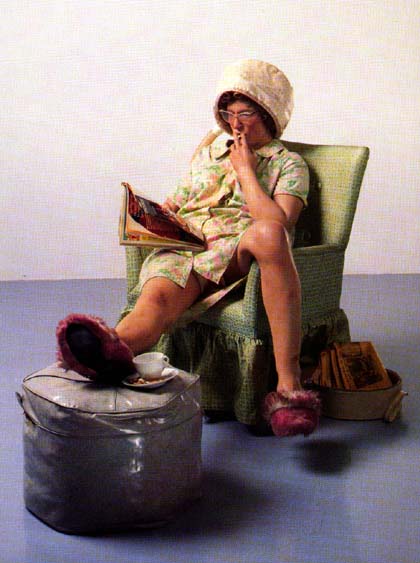

Since the feminists cultural coup, there have been only two models for stay-at-home mothers: the ineffectual, bon-bon munching ditz or the manipulative, invasive witch. No room for wits, intellectuals, creative geniuses or entrepreneurs here.
Nevertheless - and this is the secret that the femisists are desperate to keep from young women - they exist (even flourish) as stay-at-home moms to this day. What's more, they are usually raising those children who reject the current notions of adolescence. These are the women who regard motherhood as the most challenging and influencial of careers. They are Professional Mothers.
I'd like you to meet a few of the very best. Next time: Professional Mothers.
Thursday, October 13, 2005
Mother Tongue

We all remember the story of Babel, that disastrous experiment in human unity and autonomy. Men united around a single ideology of self-improvement and self-aggrandizement for the purpose of seizing a Heaven without God. God's mildly amused response to this itty-bitty uprising was to confuse men's language, literally, to confuse their "lip".
James Jordan's book, "Primeval Saints", clarifies,
"As we begin the story of the Tower of Bable we read, 'Now the whole earth used the same language and the same words' (Gen 11:1)...The phrase 'same words' refers to language, but the phrase 'same lip' - literally 'one lip' - refers to religion (Zeph 3:9; Ps 81:5; etc)...What happened at Babel was not first and foremost a division of languages, but rather a division
of religious belief..."
So what has religion got to do with language? Why would a division of religious belief have the secondary effect of dividing language?
Well, in some fundamental way God IS language. "In the beginning was the Word, and the Word was with God, and the Word was God..." (Jn 1:1) And we are created in the image of that Word.
Ephesians 1, that delicious exposition of the purposes of the Trinity in making and redeeming man, is shot through with this refrain: "to the praise of his glory...." Apparently, our underlying purpose is to glorify God, and our mother-tongue is praise. When we will not speak the praise of God, we no longer speak our mother-tongue.
But James Jordan further reflects:
"The Christian knows that God has established Christianity
to create a true unity of confession (the lip) among allnations and peoples, but this unity will not destroy the diversity of languages. Instead, each nation and language will praise Him in its own tongue (Rev 7:9)...Every language has a particular set of perspectives on the Word of God, and thus every language
is fitted to reveal God and praise Him in a special way. Throughout eternity the saints will delight to learn language after language, learning to praise God in new ways, age after age, forever and ever."
As a mother, I have a good deal of influence over what is said in my home. As I pursue a unity that does not crush the individual, I pursue God's praise. As I pursue understanding among the members of my household, I pursue God's praise. And as I pursue joy outstripping despair, I pursue God's praise.
May all our homes become fluent in praise, the song of Heaven, the language of power, and our true Mother-tongue.
Tuesday, October 11, 2005
Evolving Conflict

Douglas Wilson, author of "Why & What?", invites us, "Imagine you are mistaken about everything you hold dear. Suppose you woke up one morning and realized that your long-held, day-to-day views of nature, social values and self were obviously mistaken..."
Not likely. Yet that is exactly what we Christians expect of the non-Christians we meet. If we are bold enough to present some kind of a Christian worldview, we expect that others should gladly ditch their cherished notions, the worldview that they have believed holds back chaos and evil, in an instant.
Nowhere has my family seen this more clearly than in our work as volunteer docents at the Denver Museum of Nature and Science. This is a thorough-going secular, evolutionist institution. We knew that going in, and chose to work in the space exploration section so as to avoid having to teach against conscience.
Nevertheless, we have had plenty of opportunities to trumpet the strength of Western science as it rests on the flexibility of the scientific method, and to ask our fellow-workers (even the curators) to apply it equally to evolutionary concepts as well as to competing theories. The scientific method means that we begin by acknowleding that we do not have the whole picture and we must remain open to the new possibilities indicated by new evidence - even if they seem to support an opposing theory.
Because of our hard work learning, engaging visitors, innovating new approaches to the displays, and because of our genuine interest in our co-workers, museum staff and volunteers are willing to listen to us. They are even willing to take cautious steps toward doubting their evolutionary foundations.
However, the recent revival in court of the Creationist/Evolutionist conflict over the Dover School District policy of characterising all proposed scientific systems of origins as theories, we are facing new hostility. And some of that hostility rises from the tactics of Christians who visit the museum.
Several well-meaning Christian groups give guided tours of the museum, teaching the students they lead to mock evolutionary ideas. While this may be a fun way to build rapport with a group of students who come together for a short time, it makes a poor witness. The museum has recently released an advisory on how to deal with such Christians. Many volunteers plan to use mockery in return.
What many of us have failed to realize is that this is not a scientific debate. It is not even a rational debate. The evolutionists at the museum are, at best, ill-informed about the Intelligent Design position. Their reaction is purely emotional.
We would do well to remember that we are asking them to consider that everything they hold dear is wrong. If we would have them hear our facts, we must address their fear first.
Friday, October 07, 2005
Silencing Foes

Children die in infancy. Three of mine died before birth. Yesterday, my good friend’s granddaughter died after only a few weeks of struggle and pain in this world.
And now it is we who must struggle in pain again. Struggle against the temptation to see God as either cruel or impotent.
I have found few real comforts in the loss of little ones. But this is the chief: Psalm 8.
“Out of the mouths of children and tiny nursing babes
From the lips of the little ones, God has ordained His praise.
He has ordained His praise, because of His enemies.
Lord, give our children a heart to know You.
Let their song silence Your foes!”
(paraphrase by Judy Rogers)
My dead children, and my friend’s granddaughter will always be children. Let their songs silence His foes!
Tuesday, October 04, 2005
A Liturgy of Learning

James Jordan, in his book, Primeval Saints, has a wonderful study of the manner in which worship transforms our work and enables us in turn to transform the broken, ugly and unformed into something more and more glorious.
Jordan points out that God models for us again and again the six-fold pattern for our work.
- We lay hold on the world.
- We give thanks.
- We break it up and restructure it.
- We distribute it to others.
- We evaluate it.
- We enjoy it.
Let us apply this thinking to teaching and training our children.
- We lay hold on our child and some subject matter - say math.
- We give thanks. (Isn't this key? At my house there is a good deal of whining from the natural man when math is the subject.)
- We break it down and restructure it. (So we use small, logical pieces, turning them this way and that so that our children can grasp the concepts no matter what their learning style.)
- We distribute it. (When we have found the perspective that works for that child, we give it to them to apply to further problems. If we really want things to stick in their minds, we make opportunities for them to distribute this concept to someone else - perhaps by tutoring a younger sibling or by creating some interesting display)
- We evalutate it. (We check those practice problems, see if the machine works, taste the sauce....)
- We enjoy it. (Now, we finish the whole problem set with more ease, let the machine work for us, eat the whole dinner...)
And before we have done, we would do well to point out that this is the way they will be able to conquer any subject.
Monday, October 03, 2005
Creator of Evil?

Thought you might enjoy this as much as I did, especially in light of the disputes over a local school district's attempt to balance Evolutionary theory with a mention of Intelligent Design theory. But more on that later...
For now, "Evil, Cold & Darkness" (does anyone know who wrote this?)
Did God create everything that exists? Does evil exist? Did God create evil? A University professor at a well known institution of higher learning challenged his students with this question. "Did God create everything that exists?"
A student bravely replied, "Yes he did!"
"God created everything?" The professor asked.
"Yes sir, he certainly did," the student replied.
The professor answered, "If God created everything; then God created evil. And, since evil exists, and according to the principal that our works define who we are, then we can assume God is evil."
The student became quiet and did not answer the professor's hypothetical definition. The professor, quite pleased with himself, boasted to the students that he had proven once more that the Christian faith was a myth.
Another student raised his hand and said, "May I ask you a question, professor?" "Of course", replied the professor. The student stood up and asked, "Professor does cold exist?"
"What kind of question is this? Of course it exists. Have you never been cold?" The other students snickered at the young man's question.
The young man replied, "In fact sir, cold does not exist. According to the laws of physics, what we consider cold is in reality the absence of heat. Every body or object is susceptible to study when it has or transmits energy, and heat is what makes a body or matter have or transmit energy. Absolute zero (-460 F) is the total absence of heat; and all matter becomes inert and incapable of reaction at that temperature. Cold does not exist. We have created this word to describe how we feel if we have no heat."
The student continued, "Professor, does darkness exist?" The professor responded, "Of course it does." The student replied, "Once again you are wrong sir, darkness does not exist either. Darkness is in reality the absence of light. Light we can study, but not darkness. In fact, we can use Newton's prism to break white light into many colors and study the various wavelengths of each color. You cannot measure darkness. A simple ray of light can break into a world of darkness and illuminate it. How can you know how dark a certain space is? You measure the amount of light present. Isn't this correct? Darkness is a term used by man to describe what happens when there is no light present."
Finally the young man asked the professor, "Sir, does evil exist?"
Now uncertain, the professor responded, "Of course, as I have already said. We see it everyday. It is in the daily examples of man's inhumanity to man. It is in the multitude of crime and violence everywhere in the world. These manifestations are nothing else but evil.
To this the student replied, "Evil does not exist, sir, or at least it does not exist unto itself. Evil is simply the absence of God. It is just like darkness and cold, a word that man has created to describe the absence of God. God did not create evil. Evil is the result of what happens when man does not have God's love present in his heart. It's like the cold that comes when there is no heat, or the darkness that comes when there is no light."
The professor sat down
Sunday, October 02, 2005
Harvest Home

Every Autumn, our family celebrates the turn of the season with certain treasured rituals. We harvest our honey, and with it bake Honey Baklava. We exchange our blue, silver and crystal summer accessories throughout the house for the coral, russet and brass that light our interiors just as the turning leaves light a gloomy autumn day. We lift the crowded lilies and iris in our garden and give the excess away. We prepare the fireplace for that first magical evening which is cold enough to give us an excuse to light a fire.
As we do so, we remind ourselves that in these little celebrations, we imitate our Creator, who dresses the world according to the season. And the changes remind us to look at things with fresh eyes and renewed gratitude.
Autumn is the time to look back and gloat over the growth and harvest the Lord has brought from all our labors. Even our autumn holidays encourage this: Columbus Day, All-Saints Day, Reformation Day, Thanksgiving.
This year, I am especially giving thanks for my Grandparents, who are this Fall re-united in the Lord’s own Harvest-Home. I miss them very much. They were brave and strong. Their Wyoming homestead was where I first learned the delights of the harvest. And their faithful prayers sustained four generations through the dangers of the Journey. They taught me not to fear growing old.
I trust they are gloating….
ORCHARD SWINGS
The knife slipped as the first wave of panic licked over her like a furnace blast. Mara let out a slow breath to calm her racing heart, her blouse drenched with sweat suddenly cutting into her burning skin at throat, shoulders, wrists. She cranked the window open wide, gulping in the spicy autumn air cooled by the rustle of apple leaves just outside. Glumly, she surveyed the wedding cake bleeding from among the frosting roses where she had gouged it a moment before.
"Fifty guests in two hours. I can't do it! It's their 65th wedding anniversary. It ought to be done right, and I can't even hold an icing knife," she thought, bitterly as her Old Testament namesake.
"This isn't like you. You love entertaining. You're good at it. Hormones," she told herself firmly, "It's just hormones."
Suddenly, Mara felt disfigured, a grotesque parody of herself. "Exactly," she thought, "and it's only going to get worse." It seemed so unfair, spending decades developing skills, assembling knowlege, stretching for character, nurturing friendships and responsibilities in order to be useful, even lovely to God and His people. And now, to be trapped in this turncoat body, unable to depend on the simplest emotional resource. She could have dealt with the headaches, the hot flashes, the sleeplessness, even the sorrow of leaving childbearing behind. But the hormone-induced rage and depression left her afraid to face friends and family with that black hole sucking hard-won confidence and easy competence alike down into an uncertain abyss..."Here it is, the first kiss of death."
Shaking the tears from her cheeks, she bent to repair the damage, setting herself to think instead about the grandparents she meant to honor with the cake.
The Grandfather of her youth had been such a broad-shouldered, blustery rogue. Teasing and joking, thrilling little girls with gentle samples of his barn-storming stunt flying, weeping over his prayers. Eyes merry with mischief, he would push her in the orchard swing until at last he would swing her so high, he could run underneath her as she shrieked to the dizzy peak.
These days he shuffled with a stroke-induced paralysis in one leg, and his eyes were more often harsh with a stony determination to find the right word before someone noticed his deficiency.
Mara remembered falling asleep as a child, head pillowed on Grandmother's shoulder, lulled by the drowsy counterpoint of rustling leaves and Grandmother's prayer list. They would have spent the day climbing trees, pelting down the apples and turning them into treasures of carnelian and amber jellies, accompanied by a steady stream of family lore, homely advice, Bible stories and helpless, exhausted laughter.
Now Grandmother would not remember whether she was pouring jelly or washing the ladle. At least now it no longer troubled her. In the early stages of the Alzheimers', Grandmother had leaned on Mara's shoulder, slow tears silvering her weathered cheeks, confiding, "You have no idea how awful it is not to be able to remember things."
"Oh, I have some idea, Grandmother," Mara whispered to the icing foliage, swallowing the lump of fear and shame rising in her throat, cold with the thought of the unbroken line of women in her family who had gone down to death through that fog of forgetfulness.
The week before, Mara had watched her Grandfather choking down his exasperation, like Syssiphis, explaining again and again why Grandmother needed her good shoes for church, struggling to give her some dignitiy in her infirmities. Handing him the shoes in question, Mara had voiced the doubt welling up like a sob, "How do you keep going? What compensation does God give you in these losses?"
He flashed her his old grin. "You might think you have it good now, but whatever good things you can imagine, that's nothing to what we'll have in heaven! It's not...You can't even think about it!" he finished, words failing him on several accounts.
Turning that searchlight smile on his wife he glowed, "Right old girl?" and squeezed Grandmother's knee roguishly.
"You brute!" she squealed, slapping him for effect, "I'll show you!" And kicking on her last shoe, she showered a rain of most un-grandmotherly kisses on his laughing face. It was a pas-de-du Mara remembered from her earliest days.
**************
"Mom, do you need some help?" Mara looked up into her son's earnest face. "Everybody will be here soon. Could I put on the music or something?"
"Thanks, Daniel. And would you take over setting the food out on the table? I have to write something in the grandparents' card." Mara disappeared down the hall listening to Daniel booming out an old hymn in his brand-new baritone as he worked.
"That's the one thing Grandmother can still remember," she recalled the rich soprano that still perfumed the air wherever her grandmother was. "Every verse..every word..like breathing.."
Mara chewed her pencap, then began:
"Long ago my heart stretched itself toward your glowing harvest orchard. I longed to swing in those swings whose ropes held fast to heaven, Granddad tossing me higher & higher in the apple-scented air. Grandmother set my feet on the ladders and branches to sieze the fiery fruit and taught me the prayers that breathed through those leafy vaults.
Now the orchard is gone. But you are still teaching me to fly: swinging me up and up, over the fear and loss of old age, on our Hope of Heaven, showing me where to stand to reach the last sweets of the harvest, with prayers as artless as the falling leaves for the evergreen vaults and courts of which these are but shadows.
Love,
Naomi"
Kim Anderson
Copyright October 1996
For your 65th Wedding Anniversary
Friday, September 30, 2005
Selling Our Birthright
Esau came home from hunting starved. Jacob was cooking lentil soup. Esau demanded some and Jacob countered with a proposed trade: your birthright for instant gratification. Esau agreed!
While many in the homeschool community have felt that our counterparts in public schools have made the same exchange with the government, perhaps it is time to admit that many in the ranks of the home-schooled have also done that deal. Virtual academies, public-school "enrichment" and "outreach" programs are multiplying across the educational landscape - because homeschoolers are buying into the idea that the government ought to have a role in raising our children. And because it is easy, immediate and someone else pays for it.
Inge Cannon, homeschool pioneer and author of countless resources for homeschoolers, writes to homeschool leaders:
What Ron and I are finding as we have worked with the twenty- and thirty-somethings over the past 15-20 years at conferences and over our Education PLUS telephone lines is often a completely different worldview perspective than was prevalent in the earlier days of our ministry to home schoolers. The changes for many in the next generation (if we figure a generation to be about 18-20 years) exhibit some or most of these characteristics:
[1] They tend to be focused on sound bites-often unwilling or unable to focus concentration on a full training session such as we offer them at our conventions and seminars. Witness the fact that they often come into the speaking sessions twenty minutes late and leave twenty minutes early—easily distracted and far more interested in coming to conventions to shop. Witness how difficult it is to get them to commit to regional seminars on the very topics about which they say they need help.
[2] They tend to function much like the rest of society in terms of an entitlement mentality. This characteristic is exhibited in several ways: they feel they have paid their taxes and therefore the government owes them something in return; they feel they are sacrificing much (and they are) by being single-income families, so leaders, businesses, suppliers, speakers, etc. should provide their needs on a gratis or marginal break-even basis (reflecting a bit of the “class envy” philosophy that liberal politicians consistently promote); they often misunderstand basic economics to the point of not taking responsibility to support what they say they believe in, so that it can be available. (And more often than I wish, resenting those who would make a profit or a living at providing the services and materials they need).
[3] They welcome government controls because they are very frightened that they might jeopardize their children’s future by not completely duplicating the curriculum design and perceived requirements of the public school (this is particularly true of the parents who are approaching the high school years with their teens). In their minds the presence of government involvement somehow sanctions what they are doing and provides them with a sense of legitimate credentialing—hence, they duplicate “school” without understanding that the definition of Christian home education is a tutorial lifestyle focused upon Biblical discipleship. This is made even more difficult when they come to home education as products of the public school themselves and have not had the opportunity to learn the Scriptures well.
[4] They welcome co-ops, entire video programs, etc.—anything that will do the teaching job for them because they are too busy to do it themselves. (Please note that I do not oppose these methods as tools, but reject the total family program being saturated by these tools in lieu of personal discipleship in teaching and interaction.)
At least once a week, I return a call to a home school mother at work in a full time job away from home. Her children are usually at home educating themselves (so I’m told when I ask).
[5] They often have no clue as to what it means to reject certain real conveniences, financial or equipment grants, reimbursement of curriculum and/or supplies at significant cost to themselves—whether financial, sacrifices of time and energy, or the pressures of swimming upstream in the face of disapproval from their peers, parents and in-laws, authorities, or the like. The logic of paying for something yourself to maintain your freedom rather than accepting the handout that comes with just a few strings can be difficult to swallow—let alone defend. Choosing what is right at cost to yourself is very hard."
"Ideas have consequences", as Francis Schaeffer would remind us. Opting to invite the government to participate in our home schooling not only damages the homeschooling movement in the long run, but exposes those homes to direct government intervention. World Magazine, in its Sept 3 article, "Here Come the Strings", details this progress in Alaska, where parents once trusted government to provide funds and parent-determined access to curricula and services, now find their entire home- life legally defined by the state as a public school, subject to all the restrictions of a secular government.
"Assistant attorney general Kathleen Starsbaugh confirmed EED's interpretive broadening of the law, labeling private homes as public schools: "While it uses terminology more easily applied to the traditional classroom, it applies to public schooling however delivered." She added that dispensing public money to parents who rely heavily on religious-themed curricula also violates the Alaska Constitution and the First Amendment's establishment clause."
What seemed like a free lunch turns out to be selling our birthright for a bowl of beans. For me, it's too much to pay.
Sunday, September 25, 2005
High-Flying Homeschoolers Part 2
An Interview with Natalie and Petra
Real Grown-ups
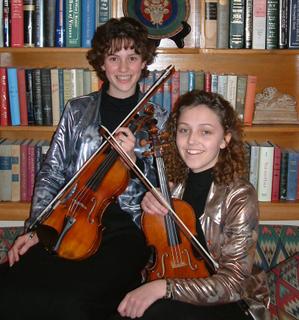
When Petra and Natalie take a break from their extraordinary feats of academics and service, they can be found laughing over their pie-baking, entertaining the dishwashers with their violins or color-coordinating their outfits for the next concert or speech. The last time they got together, they and their friends treated our assembled guests to a hilarious double-concerto, in which two musicians each played the same instrument at the same time, one fingering, one bowing; one fingering, one blowing…
They agreed to share some of their secrets of becoming real grown-ups:
Mother-Lode: What are your family’s goals in homeschooling you through high school?
Natalie: To understand my faith so that I can stand firm in it. To reason well. To develop the skills needed to change my world. To pursue excellence in academics. These four things, though they seem easy enough, demand every waking hour. Around my house we work, think, read, and discuss all day long in order to accomplish them.
Petra: In our family, the key ideas are: scholarship, stewardship and service. We work with an eye toward being good stewards of the gifts God has given us. That means pursuing the highest education I am capable of absorbing. We also work to connect our studies to real life as we go along. For instance, I applied my study of the Constitution by becoming a Teen Court Attorney and working in real court sentencing hearings to restore troubled teens to the community.
Mother-Lode: What projects in your high school career have seized your imagination?
Natalie: I know it sounds far-fetched, but really, everything I do seizes my imagination. My parents instilled in me a love of learning. Whether I’m at an orchestra rehearsal, giving a speech, or studying Advanced Placement Biology, I am fascinated.
Petra: Like Natalie, I like to take every opportunity and give it my full attention; I work hard at enjoying all the studies and projects God has put before me. I don’t know what work God has prepared for me and I don’t have time to waste, in the future I will need everything God is preparing me with now.
But specifically, the most important project so far has been my involvement in speech and debate. It has prepared me for communication with my peers and elders on a daily basis. If you want to be successful it is necessary to communicate well. A rephrasing of a quote from the movie The Emperors Men puts it in perspective “If you can not say what you mean then you can not mean what you say and everyone should always mean what they say.”
Mother-Lode: What ambitions do you have beyond high school and what has most shaped those ambitions?
Petra: I intend on pursuing an advanced degree so that if/when there are things I need to do/say in the public arena I will be credible in the eyes of the secular world. While I do not need the affirmation of the secular world, I can not minister unto them unless they can hear me. In addition, a degree will give me the background to help my husband in his endeavors and to educate my children well, while allowing me the freedom to work at home, in businesses of my own design. In line with the principles of my family’s homeschool, my two main aspirations are to exercise dominion as I serve in motherhood and politics. (Emphasis on motherhood)
Natalie: My short-term aspirations are to continue honing my public speaking skills through both live presentations and radio broadcasts. The goals of these presentations being to excite a love of learning, challenge opinions, and defy apathy.
My long-term aspirations are to pursue higher education and have a short career before settling down to raise a family. I plan to continue a lifelong pursuit of reading, learning, playing the violin, being involved in politics, and impacting my community.
Mother-Lode: What difficulties have been important for you to overcome in your school career?
Petra: Like many families we are not rich. My parents have become experts at stretching the budget. My mother has devoted her talents and income to making sure we have the educational opportunities we need. But an environment of scarcity has taught us to be creative, industrious and resourceful.
When my aunt and uncle offered to take me with them for a three month tour of Europe, there was no money in the family budget for such a thing. So my sister and I marketed the pre-school music curriculum developed by my mother, to a local Montessori school. God prospered the four-week music camp we taught there, and I had money for Europe! Now, in our third year teaching there, we have financed all sorts of extras from traveling to speech tournaments to taking music lessons.
Natalie: My family lives out in the middle of nowhere. This limits the number of outside activities in which we can participate. This made my parents very nervous! They knew that homeschooling was the right thing to do, but didn’t want us to have gaping holes in our education. But this weakness was turned into strength.
When I was five Mom started as speech club for all of the local homeschoolers. We moved to Colorado for a year when I was in the eighth grade and found a thriving speech and debate community. When we moved back home finances limited us from participating in debate. So Petra Anderson and I started the International Debate Society Network for myself and other rural homeschoolers.
Mom found resources for my brother and I to study advanced math on our own and college-level science with one or two online classes.
Living in the country has forced us to work hard, be original, creative, and independent. What we thought was a weakness has shaped us into who we are.
Mother-Lode: Do you plan to pursue higher education? Why or why not?
Natalie: I do plan to pursue higher education as an extension, if you will, of the skills being developed in our homeschool. College is a time of learning unlike any other. My mom sharpened her talents with a double-major, a minor, and a master’s degree. Without those skills, my brother and I wouldn’t be who we are today.
Currently I am planning on pursuing a bachelor’s degree and going on to get professional training as a physical therapist. This would allow me to work part time if need be, work on the missions field, and help people in my family in a practical way.
Petra: Like I said earlier, in order to communicate in the secular world often it is necessary to have a degree. As Christians we are called to restore the old waste places this means interacting with the secular world. Also, as a mother I will be better equipped to train my own children if I have a higher education, Mrs. Webb (Natalie’s mom) is a very good example of this.
Mother-Lode: Do you feel a tension between the careerism that pursuing a college degree usually implies, and your desire to be a wife and mother?
Natalie: No, I do not. I plan to get a degree that would allow for a very flexible, part-time job that would allow me to be a full-time wife and mother. I have reviewed many, many degree options and professional school programs to find training that allows for that kind of flexibility.
Petra: At the moment, no. I do see it could be a temptation in the future. But I am not so concerned about it affecting me, because of the closeness and support I get from the older women in my family, who have not pursued a career for the sake of a career. Also I have surrounded myself with friends who will keep me accountable to the goals we commonly share.
Mother-Lode: What advice would you give to someone who is trying to decide whether to homeschool in high school?
Petra: In high school, the choices you make, the friends you choose, and your relationship with your parents are all ground-shaking. Whatever precedents you set up in high school will follow you to college and to the rest of your life. Over-all the homeschool environment is a better place to find wholesome friends. It is much easier to have a close relationship with parents, who can guide you in crucial choices.
Natalie: High school is the time that you form the way you view the world. It is a time to learn and develop so that during the rest of life you are firmly grounded. Don’t get me wrong, homeschooling through high school isn’t easy. It takes lots of work both from parent and child. However, the rewards are worth it. They present themselves, not necessarily in the form of trophies and medals, but in an active mind and a heart eager to serve God and change the world.
Do you know any Real Grown-ups, who have not yet reached age 20? Tell us their story!
Real Grown-ups
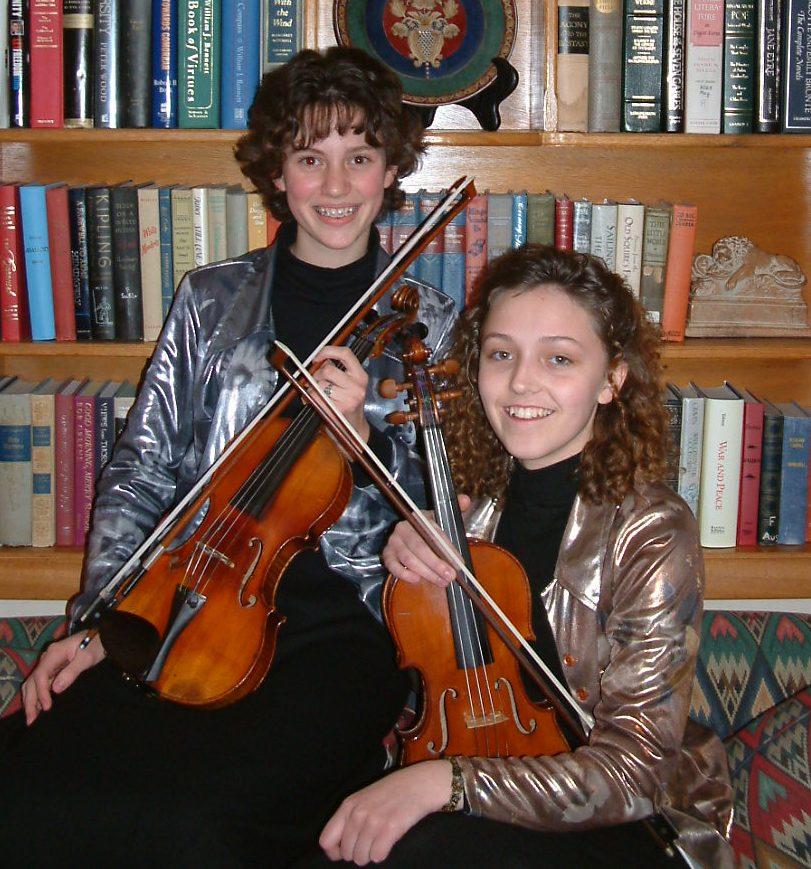
When Petra and Natalie take a break from their extraordinary feats of academics and service, they can be found laughing over their pie-baking, entertaining the dishwashers with their violins or color-coordinating their outfits for the next concert or speech. The last time they got together, they and their friends treated our assembled guests to a hilarious double-concerto, in which two musicians each played the same instrument at the same time, one fingering, one bowing; one fingering, one blowing…
They agreed to share some of their secrets of becoming real grown-ups:
Mother-Lode: What are your family’s goals in homeschooling you through high school?
Natalie: To understand my faith so that I can stand firm in it. To reason well. To develop the skills needed to change my world. To pursue excellence in academics. These four things, though they seem easy enough, demand every waking hour. Around my house we work, think, read, and discuss all day long in order to accomplish them.
Petra: In our family, the key ideas are: scholarship, stewardship and service. We work with an eye toward being good stewards of the gifts God has given us. That means pursuing the highest education I am capable of absorbing. We also work to connect our studies to real life as we go along. For instance, I applied my study of the Constitution by becoming a Teen Court Attorney and working in real court sentencing hearings to restore troubled teens to the community.
Mother-Lode: What projects in your high school career have seized your imagination?
Natalie: I know it sounds far-fetched, but really, everything I do seizes my imagination. My parents instilled in me a love of learning. Whether I’m at an orchestra rehearsal, giving a speech, or studying Advanced Placement Biology, I am fascinated.
Petra: Like Natalie, I like to take every opportunity and give it my full attention; I work hard at enjoying all the studies and projects God has put before me. I don’t know what work God has prepared for me and I don’t have time to waste, in the future I will need everything God is preparing me with now.
But specifically, the most important project so far has been my involvement in speech and debate. It has prepared me for communication with my peers and elders on a daily basis. If you want to be successful it is necessary to communicate well. A rephrasing of a quote from the movie The Emperors Men puts it in perspective “If you can not say what you mean then you can not mean what you say and everyone should always mean what they say.”
Mother-Lode: What ambitions do you have beyond high school and what has most shaped those ambitions?
Petra: I intend on pursuing an advanced degree so that if/when there are things I need to do/say in the public arena I will be credible in the eyes of the secular world. While I do not need the affirmation of the secular world, I can not minister unto them unless they can hear me. In addition, a degree will give me the background to help my husband in his endeavors and to educate my children well, while allowing me the freedom to work at home, in businesses of my own design. In line with the principles of my family’s homeschool, my two main aspirations are to exercise dominion as I serve in motherhood and politics. (Emphasis on motherhood)
Natalie: My short-term aspirations are to continue honing my public speaking skills through both live presentations and radio broadcasts. The goals of these presentations being to excite a love of learning, challenge opinions, and defy apathy.
My long-term aspirations are to pursue higher education and have a short career before settling down to raise a family. I plan to continue a lifelong pursuit of reading, learning, playing the violin, being involved in politics, and impacting my community.
Mother-Lode: What difficulties have been important for you to overcome in your school career?
Petra: Like many families we are not rich. My parents have become experts at stretching the budget. My mother has devoted her talents and income to making sure we have the educational opportunities we need. But an environment of scarcity has taught us to be creative, industrious and resourceful.
When my aunt and uncle offered to take me with them for a three month tour of Europe, there was no money in the family budget for such a thing. So my sister and I marketed the pre-school music curriculum developed by my mother, to a local Montessori school. God prospered the four-week music camp we taught there, and I had money for Europe! Now, in our third year teaching there, we have financed all sorts of extras from traveling to speech tournaments to taking music lessons.
Natalie: My family lives out in the middle of nowhere. This limits the number of outside activities in which we can participate. This made my parents very nervous! They knew that homeschooling was the right thing to do, but didn’t want us to have gaping holes in our education. But this weakness was turned into strength.
When I was five Mom started as speech club for all of the local homeschoolers. We moved to Colorado for a year when I was in the eighth grade and found a thriving speech and debate community. When we moved back home finances limited us from participating in debate. So Petra Anderson and I started the International Debate Society Network for myself and other rural homeschoolers.
Mom found resources for my brother and I to study advanced math on our own and college-level science with one or two online classes.
Living in the country has forced us to work hard, be original, creative, and independent. What we thought was a weakness has shaped us into who we are.
Mother-Lode: Do you plan to pursue higher education? Why or why not?
Natalie: I do plan to pursue higher education as an extension, if you will, of the skills being developed in our homeschool. College is a time of learning unlike any other. My mom sharpened her talents with a double-major, a minor, and a master’s degree. Without those skills, my brother and I wouldn’t be who we are today.
Currently I am planning on pursuing a bachelor’s degree and going on to get professional training as a physical therapist. This would allow me to work part time if need be, work on the missions field, and help people in my family in a practical way.
Petra: Like I said earlier, in order to communicate in the secular world often it is necessary to have a degree. As Christians we are called to restore the old waste places this means interacting with the secular world. Also, as a mother I will be better equipped to train my own children if I have a higher education, Mrs. Webb (Natalie’s mom) is a very good example of this.
Mother-Lode: Do you feel a tension between the careerism that pursuing a college degree usually implies, and your desire to be a wife and mother?
Natalie: No, I do not. I plan to get a degree that would allow for a very flexible, part-time job that would allow me to be a full-time wife and mother. I have reviewed many, many degree options and professional school programs to find training that allows for that kind of flexibility.
Petra: At the moment, no. I do see it could be a temptation in the future. But I am not so concerned about it affecting me, because of the closeness and support I get from the older women in my family, who have not pursued a career for the sake of a career. Also I have surrounded myself with friends who will keep me accountable to the goals we commonly share.
Mother-Lode: What advice would you give to someone who is trying to decide whether to homeschool in high school?
Petra: In high school, the choices you make, the friends you choose, and your relationship with your parents are all ground-shaking. Whatever precedents you set up in high school will follow you to college and to the rest of your life. Over-all the homeschool environment is a better place to find wholesome friends. It is much easier to have a close relationship with parents, who can guide you in crucial choices.
Natalie: High school is the time that you form the way you view the world. It is a time to learn and develop so that during the rest of life you are firmly grounded. Don’t get me wrong, homeschooling through high school isn’t easy. It takes lots of work both from parent and child. However, the rewards are worth it. They present themselves, not necessarily in the form of trophies and medals, but in an active mind and a heart eager to serve God and change the world.
Do you know any Real Grown-ups, who have not yet reached age 20? Tell us their story!
Sunday, September 18, 2005
High-Flying Homeschoolers
Real Grown-ups, Part 1
Alex & Brett Harris make a good point in their blog, the Rebelution, that it isn’t good enough just to best our culture’s current expectation of teenagers. They argue that the whole system of definitions and standards are hopelessly off-kilter. Every expectation drawn from allowances made for “adolescence” needs to be tossed off and replaced by another standard. Gentlemen, I couldn’t agree more!
Still it is difficult for people, who have been steeped in the notion that “adolescence” is a necessary stage of development, to imagine what young “non-adolescents” would look like. I have found a number of wonderful teenagers, who seem to define themselves completely outside the accepted norms. They are people upon whom I can depend to come through with creativity, energy, discretion, self-control and courage beyond even most adults I know.
They are the sort of people one needs if one is interested in serious cultural renewal. They are not yet the masters of their respective crafts, but unlike most adults, they are not people who “know only th e limits of the possible” (Terry Pratchet, The Last Hero).
Over the next few days, I’d like to introduce you to a few, starting with a dynamic duo of devoted friends separated by hundreds of miles.
Natalie and Petra met through their participation in the homeschool speech and debate league, NCFCA, in Colorado. Accomplished musicians, both run music studios from their homes. Both have been nationally-ranked speakers. And both have a dedication to serving others, between them racking up a jaw-dropping 650 hours of community service, facilitating hands-on exhibits at the Denver Museum of Nature and Science, teaching speech and debate, running speech tournaments for elementary school children, volunteering for local-to-national political campaigns, serving on municipal youth courts which administer restorative justice to other teens, touching literally thousands of people – and still counting. The two have a deep connection that cannot be shaken by distance or difficulty.
When Natalie’s father took a job in Oklahoma, the girls were distressed, as most friends would be, about the separation. But instead of wringing their hands, they embarked upon a project that would not only bring them closer together, but would also benefit other homeschoolers who live on the mission field or in remote rural areas. They launched the International Debate Society Network.
The IDS (pronounced “Ideas”) Network allows students to debate in real time over the internet. Petra and Natalie have lined up experienced and award-winning peer mentors, and well-respected coaches to provide teaching and training for students who have no debate experience. They will provide a series of fresh scrimmage match-ups for beginners and experienced debaters each week. Students can affiliate with the national homeschool forensics association (NCFCA), and compete in NCFCA tournaments, arriving with experience similar to that of students who can attend a debate club meeting every week. In fact, they will BE a club with all the camaraderie and personal connectedness that implies.
Incidentally, as of this writing, neither Petra nor Natalie are yet 16 years old.
There are a few spaces still available in this year’s IDS Network, which will begin its virtual meetings in October. Contact IDS Network for applications and information at ids.network@gmail.com .
Next time: An interview with Natalie & Petra
Alex & Brett Harris make a good point in their blog, the Rebelution, that it isn’t good enough just to best our culture’s current expectation of teenagers. They argue that the whole system of definitions and standards are hopelessly off-kilter. Every expectation drawn from allowances made for “adolescence” needs to be tossed off and replaced by another standard. Gentlemen, I couldn’t agree more!
Still it is difficult for people, who have been steeped in the notion that “adolescence” is a necessary stage of development, to imagine what young “non-adolescents” would look like. I have found a number of wonderful teenagers, who seem to define themselves completely outside the accepted norms. They are people upon whom I can depend to come through with creativity, energy, discretion, self-control and courage beyond even most adults I know.
They are the sort of people one needs if one is interested in serious cultural renewal. They are not yet the masters of their respective crafts, but unlike most adults, they are not people who “know only th
 e limits of the possible” (Terry Pratchet, The Last Hero).
Over the next few days, I’d like to introduce you to a few, starting with a dynamic duo of devoted friends separated by hundreds of miles.
Natalie and Petra met through their participation in the homeschool speech and debate league, NCFCA, in Colorado. Accomplished musicians, both run music studios from their homes. Both have been nationally-ranked speakers. And both have a dedication to serving others, between them racking up a jaw-dropping 650 hours of community service, facilitating hands-on exhibits at the Denver Museum of Nature and Science, teaching speech and debate, running speech tournaments for elementary school children, volunteering for local-to-national political campaigns, serving on municipal youth courts which administer restorative justice to other teens, touching literally thousands of people – and still counting. The two have a deep connection that cannot be shaken by distance or difficulty.
When Natalie’s father took a job in Oklahoma, the girls were distressed, as most friends would be, about the separation. But instead of wringing their hands, they embarked upon a project that would not only bring them closer together, but would also benefit other homeschoolers who live on the mission field or in remote rural areas. They launched the International Debate Society Network.
The IDS (pronounced “Ideas”) Network allows students to debate in real time over the internet. Petra and Natalie have lined up experienced and award-winning peer mentors, and well-respected coaches to provide teaching and training for students who have no debate experience. They will provide a series of fresh scrimmage match-ups for beginners and experienced debaters each week. Students can affiliate with the national homeschool forensics association (NCFCA), and compete in NCFCA tournaments, arriving with experience similar to that of students who can attend a debate club meeting every week. In fact, they will BE a club with all the camaraderie and personal connectedness that implies.
Incidentally, as of this writing, neither Petra nor Natalie are yet 16 years old.
There are a few spaces still available in this year’s IDS Network, which will begin its virtual meetings in October. Contact IDS Network for applications and information at ids.network@gmail.com .
Next time: An interview with Natalie & Petra
Tuesday, September 13, 2005
Aiming Arrows

“My kids are turning out OK!” say many parents I meet. Maybe. But is that what you’ve been sacrificing your time, treasure and talent for? Kids who are merely OK?
Not I. I’m aiming higher. I want children who have been trained and challenged to the limit of their abilities; children who have been polished to keen-edged beauty and usefulness. I want children who are prepared to recognize and to seize every opportunity that Providence offers; children whose vision and education enable them to make something extraordinary of the ordinary offices of life.
Today, I’d like to introduce you to a resource which will assist you to gain college entrance and scholarship funding for your homeschooled student. This is a service BY homeschoolers FOR homeschoolers. And it is so exciting that I am not even going to wait and see the final results in my own family, before I pass the recommendation on to you!
Already, by applying the principles in which this resource family will train you, my high school children (ages 15 and 18) are financing 20 credit hours at the local community college with private scholarship funds this semester alone! Their prospects for large scholarships at four-year colleges from state universities to Ivy Leagues are promising!
Meet the Webb family and their newest enterprise: Aiming Higher Consultants
Homeschoolers and Harvard
Not I. I’m aiming higher. I want children who have been trained and challenged to the limit of their abilities; children who have been polished to keen-edged beauty and usefulness. I want children who are prepared to recognize and to seize every opportunity that Providence offers; children whose vision and education enable them to make something extraordinary of the ordinary offices of life.
Today, I’d like to introduce you to a resource which will assist you to gain college entrance and scholarship funding for your homeschooled student. This is a service BY homeschoolers FOR homeschoolers. And it is so exciting that I am not even going to wait and see the final results in my own family, before I pass the recommendation on to you!
Already, by applying the principles in which this resource family will train you, my high school children (ages 15 and 18) are financing 20 credit hours at the local community college with private scholarship funds this semester alone! Their prospects for large scholarships at four-year colleges from state universities to Ivy Leagues are promising!
Meet the Webb family and their newest enterprise: Aiming Higher Consultants
Homeschoolers and Harvard
While many homeschoolers have never considered attending an Ivy League college, institute of technology, or other elite school, the benefits of doing so should be considered. A degree from a top college can put you on the fast track to influential positions in law, finance, business, engineering, science, academia, medicine, or government.
There are great personal benefits as well. A degree from an elite college can make you a more valuable employee and a more competitive candidate for professional and graduate schools. While still in college, you will have many opportunities for top internships, undergraduate research, networking, and other kinds of learning outside the classroom. Thanks to huge endowments, top colleges tend to be very generous with scholarships and/or need-based financial aid. For lower income families, an Ivy League college may be even more affordable than a local community college.
However, the process can be daunting. Last year, Harvard had a record number of applicants (22,796). They only selected 9.1% of the pool or 2,074 students. Homeschooler Austin Webb was one of those students. He was also accepted at MIT, Caltech, the University of Chicago, Rice, and Duke. He was offered approximately $200,000 in scholarships and grants at the various schools for his freshman year alone.
To help other homeschoolers take advantage of the incredible opportunities offered by elite colleges, Austin and his mother, Jeannette Webb, have founded Aiming Higher Consultants. This firm will provide professional assistance with the college application process, including application strategy, letters of recommendation, interview skills, essay editing, school documents (transcripts, course descriptions, etc.), résumés, and scholarships. To inquire about their services, email: Aiminghigherconsultants@gmail.com
To help other homeschoolers take advantage of the incredible opportunities offered by elite colleges, Austin and his mother, Jeannette Webb, have founded Aiming Higher Consultants. This firm will provide professional assistance with the college application process, including application strategy, letters of recommendation, interview skills, essay editing, school documents (transcripts, course descriptions, etc.), résumés, and scholarships. To inquire about their services, email: Aiminghigherconsultants@gmail.com
Next time: High-Flying Homeschoolers
Sunday, September 11, 2005
Flying Under the Hood

My mother got her pilot’s license before her high school diploma. She describes in glowing terms the wild freedom of soaring over the fields and curling into the embrace of the mountains that ring her childhood home in Wyoming. She reminisces about the wonder of seeing her whole dear world in one bright panorama, and the thrill of landing tight and neat on her father’s backyard airstrip, steering her father’s little Taylor-craft like an extension of herself by just leaning.
More recently, I watched my brother working toward his fixed-wing instrument rating. While it was thrilling, it was not – ever – exhilarating. To receive an instrument rating, the pilot has to spend weeks flying blind except for those instruments. The cockpit is literally shrouded from take-off to touchdown. Pilots call it ‘flying under the hood’.
They never eat before going under the hood, because the body’s entire vestibular system is horribly, nauseously confused the whole time. If you look at the instruments, they will tell you precisely where you are and whether you are banking or diving. But your mind can’t reconcile your visual record with your inner ear’s readings. There are no visual cues to tell you how the wind is catching you or whether you have overshot the runway. In fact, the only thing between you and instant death is your absolute certainty that the instruments don’t lie.
By mid-life, most of us have weathered our initial flying lessons. We’ve had our share of the power and sweep of visual flight. We’ve rescued the stranded, skirted the sudden thunderhead, landed on makeshift airstrips in strange places – at night. And we think we know flying.
So out of the blue, God slips on the hood. Nothing you can see makes any sense. Everything you feel is panic and nausea. In fact, the only thing between you and instant, eternal death is your certainty that the Scriptures don’t lie.
My husband has been taking our teenagers through the Westminster Confession of Faith. Last Sunday afternoon, we were discussing “The holy Scriptures are the only rule of faith and practice,” a theme I’ve been over dozens of times. This is the first time I’ve understood it’s a life-and-death issue. By mid-life, neither reason nor emotion are sufficient to assert, “God is good.” Certainly not in events like Hurricane Katrina or the bombings of 9-11, which many commemorated today.
Tres Shoemaker, a pilot with the Experimental Aircraft Association who helped our eldest daughter with her flying expedition for her Congressional Award, advised, “Don’t marry a pilot who doesn’t have his instrument rating.” “Why?” she asked. “Because,” Tres answered, “if you get into real trouble, only a guy who can block out the sensory and emotional distractions, using his instruments and the VOR beacons, can bring you through alive.”
Sooo, fasten your seatbelts and pass the airsick bag.
Have you been ‘under the hood?’ Click on “Comments” to tell us about it.
Monday, September 05, 2005
The Unnatural Disaster
I thought you all might be interested to read this insightful commentary on the Hurricane Katrina disaster by a non-Christian, libertarian journalist from the Intellectual Activist. http://tiadaily.com/php-bin/news/showArticle.php?id=1026
I'm taking a poll:
What do you think plays the greatest role in the destruction of New Orleans?
A. The hurricane's winds and water.
B. The Federal government's inefficiency.
C. The New Orleans/Louisiana failure to plan.
D. The entitlement mentality.
Just click on "Comments" to post your opinion.
I'm taking a poll:
What do you think plays the greatest role in the destruction of New Orleans?
A. The hurricane's winds and water.
B. The Federal government's inefficiency.
C. The New Orleans/Louisiana failure to plan.
D. The entitlement mentality.
Just click on "Comments" to post your opinion.
Tree of Life
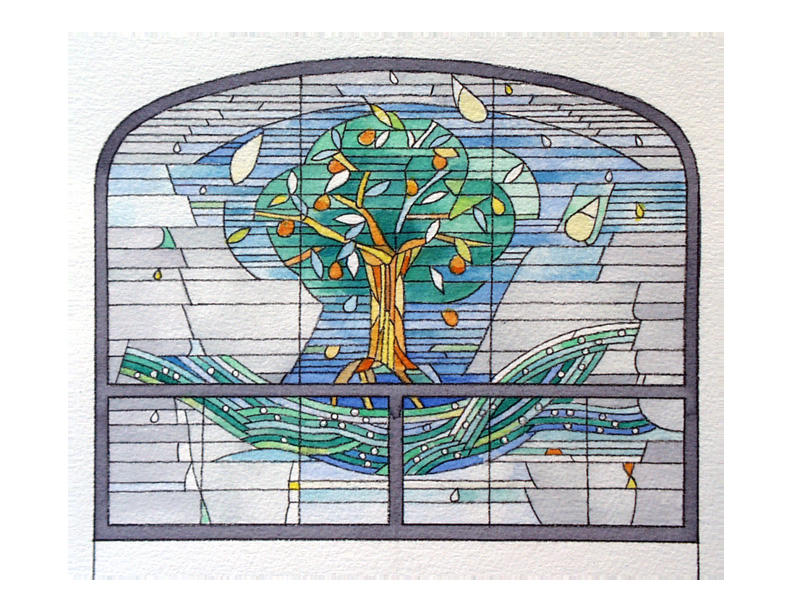
Hurricane Katrina and its aftermath provide critical opportunities to our nation; opportunities to assess not only the physical and economic devastation, but also to assess deeper devastations. We have an impetus to ask “what is the seed of the human violence added to the violence of nature?” and “Where can we look for the Tree of Life that will heal us?”
Just a few short years ago, in the wake of 9-11, the hard-boiled residents of New York City pulled together to support and encourage each other, and to laud the brave, loving souls who poured in from all over the country to help. The crime rate fell significantly. We heard story after story of courage, self-sacrifice, hope and gratitude.
Compare this to the reports we have coming out of New Orleans: looting, blaming, unspeakable crimes against fellow-refugees in the shelters provided, violence against the very people who have sacrificed to bring relief…What a contrast! The fact that there are still generous heroes who are willing not only to give time and treasure, but are also willing to brave the vicious ingratitude of those they have come to help, is evidence of a root of virtue in America that is still unshaken.
So what makes the difference? The sheer numbers of people affected? Race? Money? Government inefficiency? One of the 1,000 Katrina refugees which are being housed not 3 miles from my home wonders “why the ‘most powerful military on Earth’ couldn't subdue the armed thugs of New Orleans.”
Surely it is because, ultimately, no army on earth can subdue an idea.
The traditional American response to disaster is to look around for ways to help those less fortunate than myself – even if I, too, am a victim of that disaster. Mostly what we hear from those caught by Katrina in New Orleans is, “I deserve better than this!” “Why doesn’t somebody help me?” This kind of entitlement mentality, the idea that the world owes me a nice life, is as shocking to me as the scenes of natural devastation in the Mississippi delta.
The fruit of this idea is bitter indeed! It justifies shooting at the helicopters bringing food and water, because they “should have been here sooner”. It excuses those who actually stayed behind, hoping to profit from the rich looting after the storm. It explains away the monstrousness of violence against fellow-refugees. For if we are owed a nice life, then we have every right to be angry and impatient, even violent, when a nice life is not what is served up.
Yet is this idea operative only in New Orleans? How do I react when Providence serves up adversity? Do I succumb to the temptation to think of myself only as a victim? Do I vent my frustrations on others or excuse my own bad behavior?
Certainly, New Orleans shows us the extreme version of the entitlement mentality, but it serves as a sobering warning of things to come elsewhere, if we fail to examine our own reactions to difficulty. New Orleans will not heal on the hard rage of entitlement. Only the tears of repentance water the Tree of Life.
Subscribe to:
Posts (Atom)
LinkWithin
